Become a fan of the Society on FacebookFollow the Society on TwitterSubscribe to the Society news feed

Society for Marine Mammalogy

Home Species Species Fact Sheets Australian sea lion (N. cinerea)
Australian sea lion (N. cinerea)

SpeciesNeophoca cinerea


Discovery

Indigenous Australians had known and hunted this species (man-yini, in nyoongar dialect in south-west Western Australia) for many thousands of years prior to European settlement. The Australian sea lion was first described by Francois Péron (1816) on Kangaroo Island.


Taxonomy

  • Order: Carnivora
  • Sub-order: Pinnipedia
  • Family: Otariidae
  • Genus: Neophoca

Natural History

Size, shape and distinctive characteristics

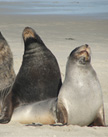
The Australian sea lion is a sexually dimorphic species with Adult males growing to 2.5m and weighing up to 300 kgs. They have a distinctive white crown and neck and are generally brown over the remainder of the body. This lead to the common name of the councillor seal. They have a short blunt snout. Adult females are approximately 60-110 kgs and 1.3-1.5 metres long. In fresh moult, they are a grey-ashen colour over the dorsal surface and have a creamy coloured ventral pelage. This can change to a light brown-coffee coloured coat in the intermoult period. Pups are born at around 4-5 kgs in size and are a dark chocolate brown colour and moult to the distinctive adult female pelage after approximately 4 months. Juveniles have the same colourings as the adult female.

Geographical distribution

View range map from IUCN Red List

Australian sea lions are an endemic species and are distributed on offshore islands from The Pages (35.759°S 138.301°E) in South Australia along the south and western coasts of Australia up to the Houtman Abrolhos Islands in Western Australia (28.666°S, 113.816°E). More than two thirds of the population is found in South Australia and the remainder of the population in Western Australia.

Ecology and Behaviour

The Australian sea lion is a polygynous breeder that displays a unique aseasonal, supra-annual (17.5 month) breeding cycle. The breeding season is also extended lasting approximately 4-5 months in most cases, though at larger colonies it has been recorded to last up to 7 months. This makes this species unique among pinnipeds. This has resulted in extremely high levels of population genetic subdivision, akin to island populations of terrestrial mammals than to other marine mammal species. Females appear to be almost exclusively philopatric, resulting in local recruitment of females to individual colonies.


This species is polygnynous, but in most colonies males will sequentially defend individual females as opposed to maintaining a territory and a harem. This species will range over the entire island and are capable of climbing the tall granitic peaks on breeding islands. Females will give birth and then come into oestrous 5-7 days post-partum during which time they are defended by a single male. Adult females will stay on land and suckle the pup for 1-2 weeks before beginning foraging trips to sea. Pups are usually weaned after about 17 months but in some cases will suckle for as long as 34 months. It appears that pups begin foraging for their own food at about 6-8 months of age.

The Australian sea lion demonstrates a restricted foraging range within the vicinity of the breeding and haulout sites. Foraging studies have shown that this species is almost exclusively a benthic forager, undertaking short foraging trips across the continental shelf ranging up to 100 kilometres from a central place. Dive depths are mostly restricted to 100 metres depth for adult females and juveniles but adult males may exceed this. There appear to be site specific foraging patterns for animals among colonies and also among individuals within colonies. There is some evidence of foraging specialisations among adult females in some colonies related to their size (smaller animals are shallow divers, larger animals are deeper divers).

Life History

This species is unique among pinnipeds as it has a temporally asynchronous breeding cycle of approximately 17.5 months. This is in stark contrast to the synchronous annual cycle of all other otariidae species. The timing of breeding appears to be random, though there are clusters of colonies that share a common breeding season. This means that there is breeding activity going on at all times of the year somewhere across the range, and that an individual adult female will give birth and breed at all seasonal times throughout her lifetime.

The 17.5 month breeding cycle is made up of 4-5 months of diapause of the blastocyst, followed by 12-13 months of active gestation. The length of the breeding cycle of individual females appears to be influenced by sea surface temperatures during the active gestation phase.


Adult females will have their first pup at approximately 4.5 years of age (3 breeding cycles) and have been recorded to live to 27 years. Adult males probably reach maturity around 7 years but are not fully mature until around 9-10 years and may live as long as 25 years.

Diet

Relatively little is still known of the diet of Australian sea lions as traditional techniques of analysing hard parts within scats are uninformative due to the highly processed material. This species invariably has gastroliths of granite in the stomach to help in processing prey. Known prey items include important commercial species such as octopus and western & southern rock lobster but also includes benthic rays and sharks, cuttlefish and squid and some benthic fishes. There are undoubtedly geographic, seasonal and ontogenetic patterns in diet among this species, which are the focus of current research programmes.


Population Status

Global Abundance

This species was hunted primarily for its oil and skins throughout the 18-19th centuries until it became commercially extinct. It appears to have suffered a range reduction, having been wiped out of the Bass Strait and has yet to return. Estimates of pristine abundance are difficult to obtain but the Kangaroo Island population was once much larger than present and also more widespread on the island than the contemporary distribution.

This species is one of the rarest pinnipeds in the world with approximately 12-14000 animals. This species is only found within the waters of two states within Australia and as such has one of the smaller ranges of pinnipeds worldwide as well. Current trends in population size suggest that some colonies are suffering declines in abundance and are at risk of localised extinctions. It is currently listed as a threatened species (Vulnerable category) under the Commonwealth Environmental Protection and Biodiversity Conservation Act (1999).


IUCN status

This species is currently listed as endangered based on concerns over declines in abundance and limited population size (IUCN 2009).


Conservation Issues

The ASL is protected by both State and Commonwealth laws throughout its range. However, due to its foraging behaviours and distribution this species overlaps extensively with commercial and recreational fishing operations throughout most of its range. Entanglement in marine debris and incidental mortality are listed as key threatening processes for this species. Mitigation of bycatch in the pot (trap)-based lobster fisheries are in place in both Western Australia and South Australia. Management plans to address concerns over the bycatch of this species in demersal-set gillnets are also in development and will be monitored closely to judge their efficacy in helping to conserve this threatened species. It is also likely that some competition for resources occurs in some parts of the range. The western sub-population of ASL is also likely to suffer from increased ambient and sea surface temperatures as further global warming effects manifest.


Authors


Key References

Campbell, R. A., Gales, N. J., Lento, G. M. and Baker, C. S. (2008). Islands in the sea: extreme female natal site fidelity in the Australian sea lion, Neophoca cinerea. Biology Letters, 4: 139-142.

Campbell, R.A., Holley, D., Chrisianopolous, D, Caputi, N and Gales, N.J. (2008). Mitigation of incidental mortality of Australian sea lions in the west coast rock lobster fishery. Endangered Species Research 5:345-358.

Costa, D.P. and Gales, N.J. (2003). Energetics of a benthic diver: seasonal foraging ecology of the Australian sea lion, Neophoca cinerea. Ecological Monographs, 73(1): 27-43.

DEWHA (2010). Recovery Plan for the Australian Sea Lion (Neophoca cinerea). Technical Issues Paper. Canberra, March 2010.178pp.

Fowler, S.L., Costa, D.P., Arnould, J.P.Y., Gales, N.J. and Kuhn, C.E. (2006). Ontogeny of diving behaviour in the Australian sea lion: trials of adolescences in a late bloomer. Journal of Animal Ecology, 75, 358-367.

Gales, N.J. and Cheal, A.J. (1992). Estimating diet composition of the Australian sea lion Neophoca cinerea from scat analysis: an unreliable technique. Wildlife Research, 19: 447-456.

Gales, N.J., Shaughnessy, P.D. and Dennis, T.E. (1994). Distribution, abundance and breeding cycle of the Australian sea lion, Neophoca cinerea (Mammalia: Pinnipedia). Journal of Zoology, London, 234: 353-370.

Gales, N. J., Williamson, P., Higgins, L.V., Blackberry, M.A. and James, I. (1997). Evidence of prolonged post-implantation period in the Australian sea lion (Neophoca cinerea). Journal of Reproduction and Fertility, 111: 159-163.

Goldsworthy, S.D. and Page, B. (2007). A risk-assessment approach to evaluating the significance of seal bycatch in two Australian fisheries. Biological Conservation 139, 269-285.

Goldsworthy, S.D., Hamer, D. and Page, B. (2007). Assessment of the implications of interactions between fur seals and the southern rock lobster and gillnet sector of the Southern and Eastern Scalefish and Shark Fishery (SESSF) in South Australia. SARDI Aquatic Sciences Publication Number F2007/000711-1. SARDI Research Report Series No 255. 164 pp.

Higgins, L.V. (1993). The nonannual, nonseasonal breeding cycle of the Australian sea lion, Neophoca cinerea. Journal of Mammalogy, 74: 270-274.

Higgins, L.V. and Gass, L. (1993). Birth to weaning: parturition, duration of lactation, and attendance cycles of Australian sea lions (Neophoca cinerea). Canadian Journal of Zoology, 71: 2047-2055.

Jarman, S.N., Gales, N.J., Tierney M., Gill, P.C. and Elliott, N.G.(2002). A DNA-based method for identification of krill species and its application to analysing the diet of marine vertebrate predators. Molecular Ecology, 11, 2679-2690.

Kemper, C.M., Pemberton, D., Cawthorn, M., Heinrich, S., Mann, J., Würsig, B., Shaughnessy, P. and Gales, R. (2003). Aquaculture and marine mammals: co-existence or conflict? In Gales, N., Hindell, M. and Kirkwood, R.. (eds), Marine mammals and humans: fisheries, tourism and management issues. CSIRO Publishing, Melbourne, pp. 208-225.

Ling, J.K. (1999). Exploitation of fur seals and sea lions from Australian, New Zealand and adjacent subantarctic islands during the eighteenth, nineteenth and twentieth centuries. Australian Zoologist, 31: 323-350.

Ling, J.K. and Walker, G.E. (1976). Seal studies in South Australia: progress report for the year 1975. South Australian Naturalist, 50: 59-68, 72.

Ling, J.K. and Walker, G.E. (1978). An 18-month breeding cycle in the Australian sea lion? Search, 9: 464-465.

Lowther, A. D. and Goldsworthy, S. D. (2011). Detecting alternate foraging ecotypes in Australian sea lion (Neophoca cinerea) colonies using stable isotope analysis. Marine Mammal Science, 27. doi:10.1111/j.1748-7692.2010.00425.x

Page, B., McKenzie, J., McIntosh, R., Baylis, A., Morrissey, A., Calvert, N., Haase, T., Berris, M., Dowie, D., Shaughnessy, P.D. and Goldsworthy, S.D. (2004). Entanglement of Australian sea lions and New Zealand fur seals in lost fishing gear and other marine debris before and after Government and industry attempts to reduce the problem. Marine Pollution Bulletin, 49: 33-42.

Shaughnessy, P.D. (1999). The Action Plan for Australian Seals. Environment Australia, Canberra. 116 pp.

Shaughnessy, P.D., Dennis, T.E. and Berris, M. (2007). Predation on Australian sea lions Neophoca cinerea by white sharks Carcharodon carcharias in South Australia. Australian Mammalogy, 29: 69-75.

Shaughnessy, P., Kirkwood, R., Cawthorn, M., Kemper, C., and Pemberton, D. (2003). Pinnipeds, cetaceans and fisheries in Australia: a review of operational interactions. In Gales, N., Hindell, M., Kirkwood, R. (eds), Marine mammals and humans: fisheries, tourism and management issues. CSIRO Publishing, Melbourne, pp. 136-152.

Shaughnessy, P.D., Simon D. Goldsworthy, S.D., Hamer, D.J., Page, P.D., McIntosh, R.R. (2011). Australian sea lions Neophoca cinerea at colonies in South Australia: distribution and abundance, 2004 to 2008 Endangered Species Research 13: 87-98.