Become a fan of the Society on FacebookFollow the Society on TwitterSubscribe to the Society news feed

Society for Marine Mammalogy

Home Species Species Fact Sheets Harbor porpoise (P. phocoena)
Harbor porpoise (P. phocoena)

SpeciesPhocoena phocoena


Discovery

The harbour porpoise was classified and named Phcoena phocoena by Linneaus in 1758. However, descriptions of this species are found much earlier than this, as it has been a common and well-known coastal toothed whale species in Europe throughout the development of the human civilization in these areas.  


Taxonomy

  • Order: Cetartiodactyla
  • Cetacea (unranked)
  • Odontoceti (unranked)
  • Family: Phocoenidae
  • Genus: Phocoena

Natural History

Size, shape and distinctive characteristics

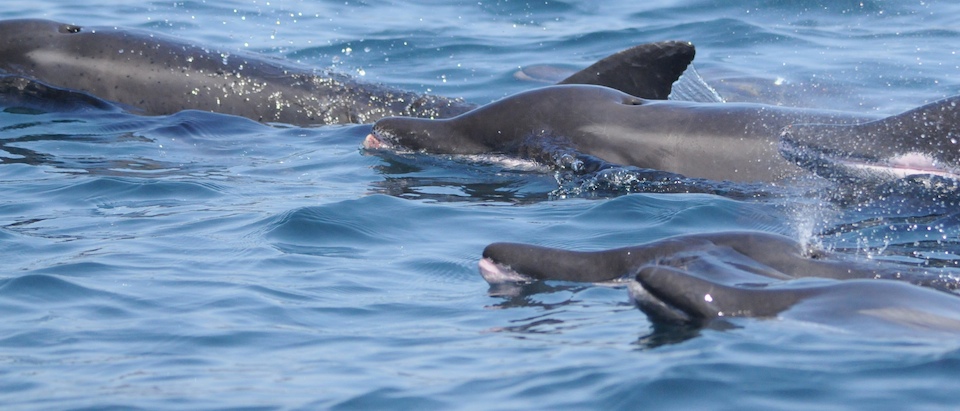
Harbour porpoise is a very small toothed whale with a small dorsal fin and a rounded snout. On the dorsal side they are dark grey and on the ventral side white.

Length Males 1.35-1.55 m, Females 1.4-1.7 m

Weight Males Up to 55 kg, Females Up to 70 kg

Longevity: 22-25years, but less than 5% live beyond 12 years of age.

Births occur from May to August, with peak in June. Gestation is estimated to 10-11 months. Each birth consists of one calf.


Geographical distribution

View range map from IUCN Red List

Mainly inshore and relativley shallow waters around the coasts of the North Atlantic and North Pacific. In the Atlantic they are found from Spitzbergen  and Greenland in the north to the coast of Mauretania in the south.

Ecology and Behaviour

Harbour porpoises are notoriuosly difficult to approach by boat. They are relatively shy animals usually sighted in smaller groups of single up to some 10s of individuals. Some times groups of several 100 animals have been observed feeding together, but such large groups are probably merely to be looked at as feeding aggregations rather than social units. Very little is known about their social behaviour in the field. From studies in captivity we know there are physical and acoustical behavioural interactions both within and between sexes. The new-born calf will stay with her mother for nursing during 6-10 months, but probab ly stay around the mother much longer than this, perhaps to learn hunting strategies et cetera.

Some harbour porpoise populations have been known to migrate, and satellite tagged individuals have been shown capable of travelling considerable distances, e.g. from Danish waters to the Shetland Islands and back again. However, at least for the animals in the inner Danish waters the same satellite taggings indicate that most harbour porpoises perform only restricted seasonal and diurnal movements.


Life History

Harbour porpoises are born in the summer, probably in shallow waters. The calf is nursing for 6-10 months but is usually starting to hunt for fish before nursing ends. The animals are sexually mature at an age of about 3 years, but females usually get their first calf at an age of about 5-6 when they have reached a weight beyond 50 kg. The females usually obtain one calf every or every second year and can stay fertilae until up to more than 18 years of age. The mating season probably occurs in late summer, even though mating attempts are also observed throughout spring and summer. The large testis and penis of the males,as well as their smaller body size compared to females, is indicative of a mating system involving so-called sperm competition. 

Harbour porpoises can reach an age well beyond 20 years, but most animals die much earlier due to diseases (especially parasites) and by entanglement in fishing gear.


Diet

Harbour porpoises feed on smaller fish and cephalopods. In the Atlantic there has been found all kinds of fish species in their stomachs, such as capelin, herring, sprat and sandeels, but also smaller gadoids and gobids and flat fishes of various species.


Population Status

Global Abundance

There is no assessment of the global abundance. The most reliable abundance estimate is from European North Sea are with a total of 231.000 in 2005. A similar investigation in 1994 gave higher numbers, 288.000, albeit the distribution of harbour porpoises was very different between these two years. Evidently any such population numbers is prone to very large errors, so the above-mentioned differences in numbers are not statistically signigicant. In some areas of the world, such as the Black Sea and the Baltic Sea, the number of porpoises has dwindled during the past decades and the populations in these areas are on the rim of extinction.


IUCN status

Overall classified as Red list Least Concern (LC).


Conservation Issues

Even though there is still large populations also in heavily industrialized waters of Europe, US, Canada and Japan, Harbour porpoises are sensitive to human disturbances in terms of fishing (bycatch in gill nets), noise (from e.g. construction work using pile driving), et cetera.  


Authors

  • Magnus Wahlberg, Fjord&Baelt


Key References


Read, A. J. 1981. Harbour porpoise, Phocoena phocoena (Linneaus, 1758), In: SH Ridgway and R Harrison (Eds.): Handbook of Marine Mammals, Vol. 6, Academic Press, pp. 323-356.

Teilmann et al. 2008. High density areas for harbour porpoises in Danish waters. NERI Technical Report NO. 657, 45 pp and Appendix.